Cedar siding staining and house painting in Lincolnshire, IL (60069)
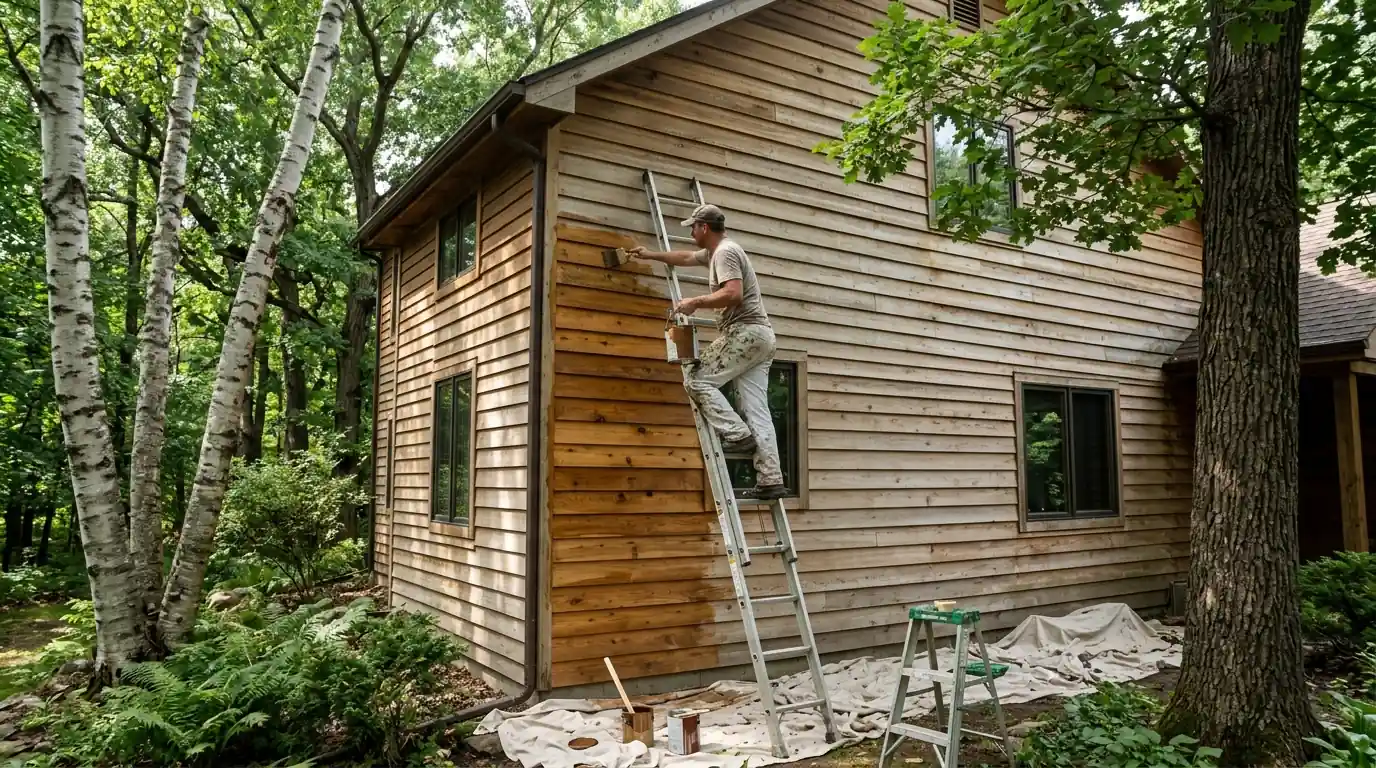
Lincolnshire runs along the Des Plaines River in Lake County, and many of its 1970s to 1990s two-story and custom homes sit on wooded lots with cedar siding. That shade keeps the wood damp, which shapes how we stain and paint here.
Short answer
In Lincolnshire we stain and paint cedar siding on 1970s to 1990s homes, refinish decks and repaint interiors. Cedar staining runs $1.95 to $4.40 per square foot, soffit and fascia $4.35 to $9.80 per linear foot, and interior walls $465 to $890 a room. Weathering, mildew, wall height and how much old stain must come off set the final price.
From Park Ridge up Milwaukee Avenue to Lincolnshire
Lincolnshire lies north of us in Lake County. Depending on the hour, we take the Tri-State or drive straight up Milwaukee Avenue, past the Marriott Theatre, to reach most streets in the village. It is close enough that we can return the morning after a rain delay without giving up a full day.
The calls we get from Lincolnshire tend to be about wood. A cedar wall that has gone dark and blotchy, a deck that soaks up water instead of beading it, fascia boards peeling under the gutters. Interior repaints come too, often in two-story foyers and family rooms with tall walls.
Every job starts with a walk around the house and a look at how the trees affect each side. The walls under the heaviest canopy are usually the ones that need the most cleaning, the most drying time and the closest look for soft boards.
Cedar on a damp, shaded lot needs a different plan
Cedar is a good siding, but it does not like staying wet. On Lincolnshire's wooded lots, shade slows drying after every rain, so mildew takes hold, the surface grays and older stain wears through unevenly. We clean with a wood cleaner, brighten the cedar to bring back its color and wait for it to dry before any stain goes on.
The choice between semi-transparent and solid stain depends on what we find. If the boards are sound and fairly even, a semi-transparent stain lets the grain show through. If earlier coats were solid, or the wood has weathered in patches, a solid stain gives a uniform color and hides the blotches.
Homes built from the 1980s on fall after 1978, so the EPA lead rule usually does not apply to them. Houses from the 1970s may be older than that cutoff, so we ask about the build year and follow lead-safe practices whenever a home predates it.
Lincolnshire picks for cedar, decks and tall rooms
These follow the cedar-sided, wooded-lot homes most common in the village.
Cedar Siding Staining
Shaded cedar is cleaned, brightened, dried and stained in the finish that fits its condition.
Deck Staining & Sealing
Decks under tree cover are washed, checked for soft boards and sealed so they shed water again.
Soffit & Fascia Painting
Fascia under overflowing gutters peels first, so we scrape, prime and recoat it and flag any soft spots.
Pressure Washing
A gentle wash removes mildew and algae from shaded walls before stain, or as yearly upkeep.
Interior House Painting
Two-story foyers and great rooms in 1980s and 1990s homes get repainted with ladders and planks set up safely.
Ceiling Painting
Tall vaulted and stairwell ceilings are rolled evenly so no lap marks show in the afternoon light.
Wood Rot Repair
Cedar trim and sill boards that stayed wet too long are cut back and replaced before staining.
Lincolnshire details we look at first
Which side gets no sun
Walls that stay shaded all day need extra cleaning and drying time, so we stain them on the warmest, driest days of the job.
What the old stain is
Cedar that already carries solid stain can't easily go back to a see-through look. We check what is on the wood now before suggesting a finish.
Gutter overflow marks
Streaks and peeling right under the gutters point to overflow. Getting the gutters cleaned or fixed before we paint keeps the new fascia coat from failing.
Cool spring and fall mornings
April lows near O'Hare average about 40F and October lows about 45F, and shaded cedar warms slowly. We check the can for its minimum temperature and start later in the day when needed.
Questions from Lincolnshire
How often should cedar siding be restained on a Lincolnshire home?
It depends on shade and the finish. Semi-transparent stain on a heavily shaded wall wears faster than solid stain on a sunny one. We look at how evenly the color has faded and whether water still beads on the surface before suggesting when to recoat.
What does cedar siding staining cost in Lincolnshire?
Cedar staining usually runs $1.95 to $4.40 per square foot. Wall height, mildew, weathering, the amount of old finish to remove and any wood repairs move the total. We measure the house and price each side so you can see how the number is built.
Can you paint the two-story foyer in my Lincolnshire house?
Yes. We set up ladders and planks or a small scaffold to reach the upper walls safely, cover the floor and stairs, and cut clean lines along the top. Walls with two coats typically run $465 to $890 per room, the extra height pushes a foyer toward the upper end, and the ceiling is priced separately at $245 to $520.
Does lead-safe prep apply to my Lincolnshire home?
Only if it was built before 1978. Homes from the 1980s and 1990s fall after that cutoff, but some 1970s houses do not. If the build year is unclear, we test before we scrape or sand.
Painting in Lincolnshire? Call us
Call any hour. Someone picks up, takes the details and books a time to walk the job with you.