Interior House Painting
Walls, ceilings and trim in occupied homes, with furniture moved, floors covered and rooms handed back each evening.
DetailsInterior painting
We paint ceilings in homes across Park Ridge and the nearby suburbs, from low drywall ceilings in brick ranches to vaulted split-level living rooms and two-story Georgian foyers. Stains get sealed, cracks get taped, and the finish dries flat and even.
Short answer
Ceiling painting means clearing and covering the room, repairing cracks and stains, priming where needed and rolling two coats of flat ceiling paint without lap marks. Around Park Ridge the common jobs are leak stains under bathrooms, nail pops in postwar drywall and cracked plaster in older homes. A typical room runs $245 to $520, with height, stains and repairs moving the price.
Paint lines we use most, matched to the surface: Benjamin Moore, Sherwin-Williams and PPG for walls and trim, Romabio for limewash, Cabot and Sikkens for wood stain.
Light from windows and fixtures runs across a ceiling at a low angle, so every roller lap, thin spot and patch edge shows up. That is why we use flat ceiling paint, roll the whole surface while the edge is still wet, and work across the room away from the main window so the light hides the direction of the rolls rather than catching them.
Cutting in matters more on a ceiling too. A wavy line where the ceiling meets the wall color is the first thing people notice. We brush the line by hand against the wall, and where an old repaint left a ragged edge, we caulk the corner first so the new line has something straight to follow.
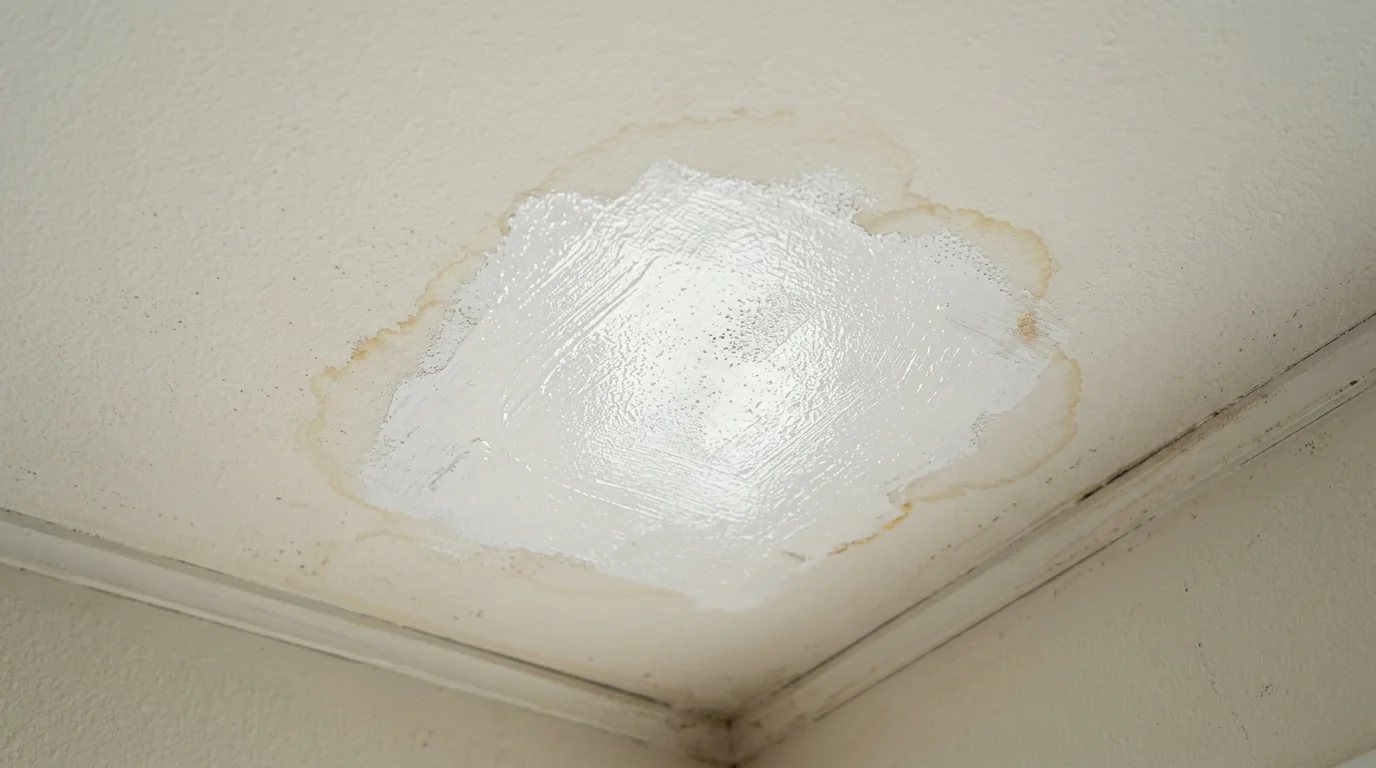
The most common ceiling call we get is a brown ring under a bathroom, an ice dam stain near an outside wall, or a yellowed patch above a fireplace or stove. Regular latex paint will not hold those back. The stain is water soluble and bleeds right through, usually within a day or two.
We first make sure the source is fixed, because a ring that is still damp will return under any primer. Then we spot prime with a shellac-based or oil-based stain blocker such as Zinsser BIN or Cover Stain, and once that dries, the full ceiling gets two finish coats so the repaired spot does not look different in raking light. Ice dams are a real winter issue on suburban homes with low-slope roof sections, so we see these stains every spring.
Drywall ceilings in postwar ranches and split-levels often show a straight line of nail pops along the joists, or tape seams that have cracked open where trusses move with the seasons. We reset the fasteners with screws, retape the failing seams and skim the area flat before priming.
Older homes in Evanston, Oak Park, Wilmette and the North Shore often have plaster ceilings on wood lath. A crack that runs across the room in a straight line, or a section that gives when you press it, means the plaster keys have broken. We reattach loose areas with plaster washers before any patching, and a ceiling that has pulled away over a wide area becomes a plaster repair job we price separately.
Some very old ceilings carry calcimine, a chalky early finish that paint will not stick to. If a wet sponge turns it milky, we wash it off or seal it with a primer made for the purpose before painting.
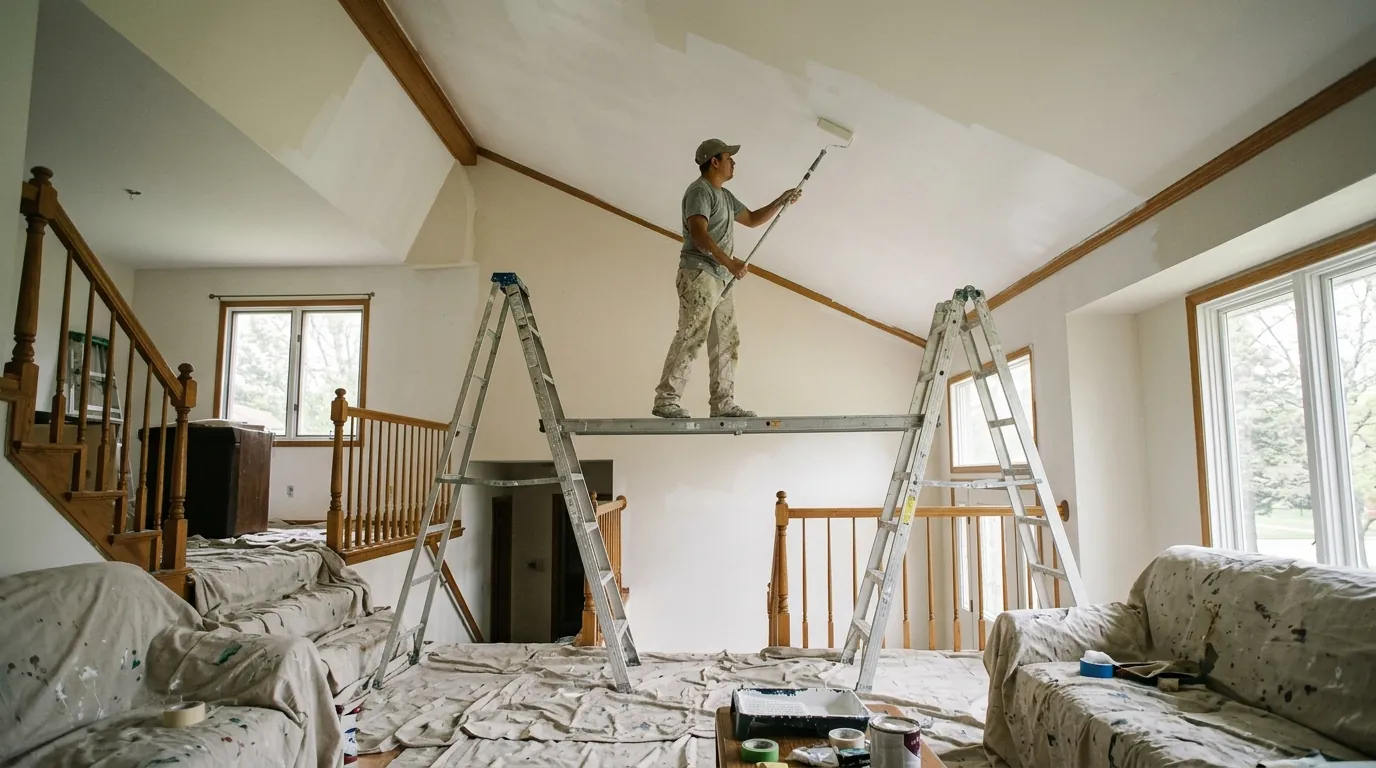
Raised ranches and split-levels around Mount Prospect, Arlington Heights and Palatine often have a cathedral ceiling over the main floor, and many Georgians and Colonials in Park Ridge and Glenview have a two-story foyer or stairwell. Those need plank and ladder setups or a small scaffold on the stairs, padded where they touch the floor and walls.
We set the staging once and paint the ceiling, then the upper walls, before taking it down. That saves a second setup and keeps the cost lower than doing the stairwell in pieces.
These are the ceiling problems we look for before we quote, because each one changes the prep.
Old leak and ice dam stains need a stain-blocking primer, or they come back through new paint.
Cooking residue and fireplace smoke leave a film that has to be washed and primed.
Nail pops along a joist mean the drywall has loosened and needs screws before paint.
A ceiling that dips or gives under light pressure needs repair, not paint.
Usually a sign of bathroom moisture or paint over an old chalky finish that paint never gripped.
Stripes that show in morning light mean the last coat was rolled without a wet edge.
We check stains for moisture, press on cracks and test old paint for adhesion and calcimine.
Furniture goes to the middle or out, floors get covered, and fixtures and smoke detector covers come down.
Fasteners get reset, seams retaped, plaster reattached and stains spot primed.
We brush the line along the walls and around fixtures before rolling.
Each coat is rolled across the whole ceiling with a wet edge so no lap marks form.
We hold a work light low across the ceiling and touch up anything thin before we pack up.
Most ceilings are priced per room, with stain blocking and repairs listed as separate lines.
| What is priced | Typical range | Unit |
|---|---|---|
| Ceiling, prep and two coats | $245 to $520 | per room |
| Drywall small patch or nail pop run | $185 to $435 | each |
| Water-damaged drywall section | $460 to $1,240 | each |
| Plaster crack or small area repair | $265 to $780 | each |
| Lead-safe setup | $145 to $385 | per room |
These ranges are typical, and the walk-through sets the real number for your ceilings.
Full painting price guideThe housing around our Park Ridge headquarters gives us a few repeating ceiling jobs. Brick ranches in Niles, Des Plaines and Morton Grove have flat eight-foot drywall ceilings that are quick to paint but often show nail pops and a bathroom leak stain or two. Split-levels and raised ranches add vaulted ceilings that need ladders and planks, and Georgians in Park Ridge add the two-story foyer.
Winters near O'Hare average lows below freezing from December through February, and the freeze and thaw of snow on the roof is what causes ice dams. That is why so many suburban ceiling stains sit along an outside wall. In older plaster homes in Evanston, Oak Park and Wilmette, we treat ceilings as possibly lead-coated and set up containment before any scraping.
We take ceiling painting jobs in Park Ridge and the suburbs around it. A few of the places we work most:
Not usually. A flat ceiling white with a touch of the wall color reads cleaner than a bright trim white overhead. We can tint the ceiling paint slightly toward your wall color so the room looks finished rather than boxed in.
The stain is water soluble, so ordinary latex paint pulls it back to the surface. It needs a shellac or oil-based stain blocker first. If the stain darkens again after that, the roof or gutter problem has not been fixed yet.
Yes, but not directly. Calcimine is chalky and paint peels off it. We either wash it off or seal it with a primer made to lock it down, then apply the finish coats.
A standard room with light repairs usually takes most of a day, including drying time between coats. Stains, plaster repair or a tall foyer can add a day.
No. Small items and breakables should be moved, but we can shift large furniture to the center and cover it. For a full ceiling skim or stain repair, clearing the room gives us more space and speeds the job.
Usually yes. Most split-level and raised ranch cathedral ceilings can be reached with extension poles, ladders and planks. We look at the peak height and the floor layout at the walk-through and plan the staging before we start.
Walls, ceilings and trim in occupied homes, with furniture moved, floors covered and rooms handed back each evening.
DetailsTextured ceilings tested, wetted, scraped, skim coated and primed so the room ends up with a smooth painted ceiling.
DetailsHoles, cracks, water stains and nail pops patched, taped, sanded and primed so the repair disappears under the paint.
DetailsCracked and bulging plaster on vintage walls reattached, patched and skimmed with materials that move like the original.
DetailsCall any hour. Someone picks up, takes the details and books a time to walk the job with you.