Siding Painting
Wood clapboard, cedar shingle, fiber cement and aluminum siding cleaned and coated with the right primer for each.
DetailsExterior painting
We repaint two-story Colonials, sided split-levels and the trim on brick ranches and Georgians across Park Ridge and the nearby suburbs, from May into October. Every job starts with washing, scraping, priming bare wood and caulking, then two finish coats.
Short answer
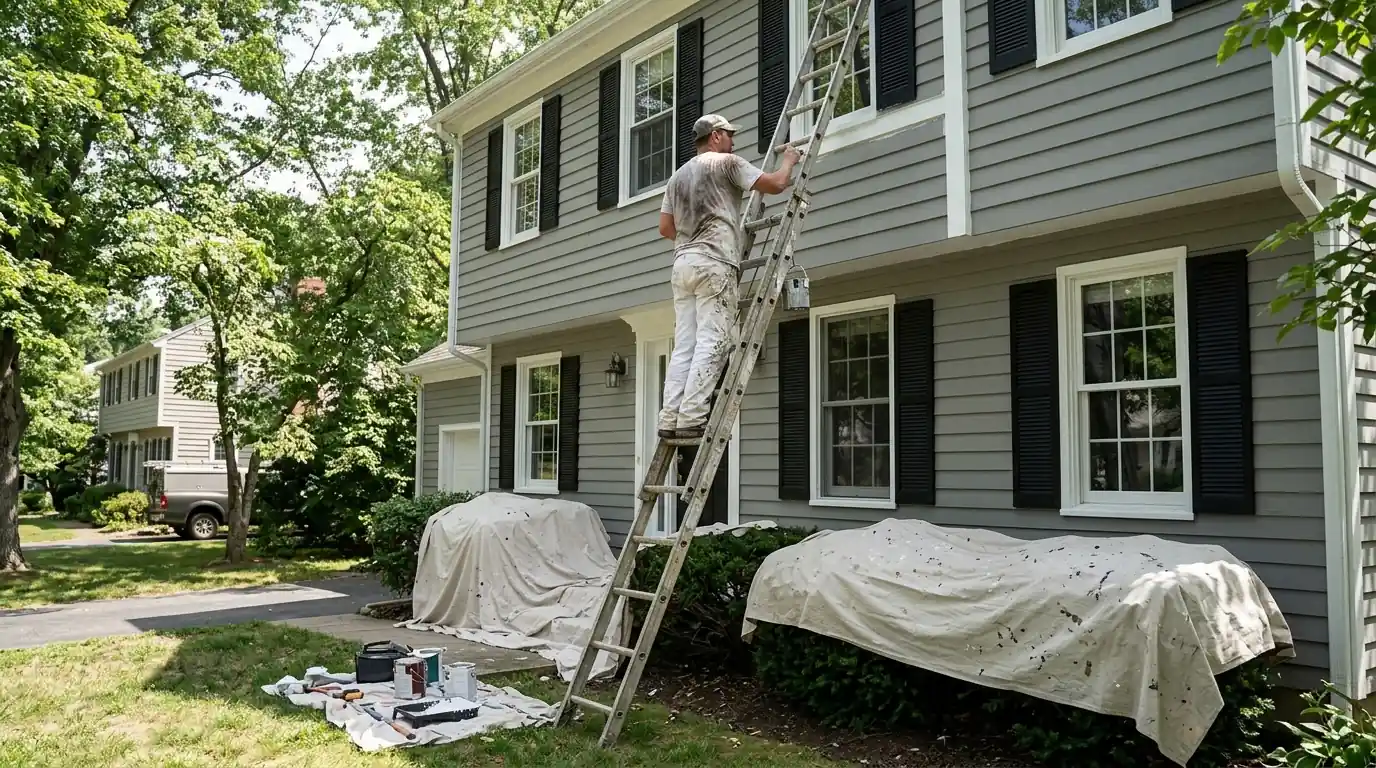
Exterior house painting is a full repaint of siding, trim, windows, doors, eaves and porches: wash, scrape, repair soft wood, prime bare spots, caulk open joints, then apply two finish coats. Around Park Ridge the season runs roughly May through October, set by overnight lows. A two-story frame or sided house typically costs $7,850 to $16,400, while trim, soffits and the garage door on a brick ranch run $2,940 to $6,480.
Paint lines we use most, matched to the surface: Benjamin Moore, Sherwin-Williams and PPG for walls and trim, Romabio for limewash, Cabot and Sikkens for wood stain.
Most of an exterior repaint is prep. On a two-story Colonial with wood or cedar siding, we wash off the pollen, maple seed residue and road film, scrape every loose edge, sand the ridges so old paint lines do not show through, and prime any wood that has gone bare. Then we caulk the seams where trim meets siding and where window casings meet the wall, because those joints let water in first.
Only after that do the finish coats go on. We apply two coats of a quality exterior acrylic on siding and trim, brushed and rolled where it counts, and we cut a straight line where body color meets trim color. Shutters, the front door, eaves, gutters if you want them, the porch and the garage door are all written into the scope before we start, so nothing gets dropped on the last day.
Brick ranches and Georgians are a different job. On those houses the walls usually stay as they are, and the paint work is trim, window frames, soffits, fascia, shutters, the front entry and the garage door. That scope costs less than a sided house but takes careful cutting against the brick, and we cover painting the brick itself on its own page.
Paint cares about surface temperature, overnight lows and dew, not the month. Most exterior paints list a minimum application temperature somewhere between 35F and 50F depending on the product, so we check the can for each job. The paint also needs a few hours above that minimum before evening dew settles on it.
The O'Hare normals, measured a few miles from our Park Ridge shop, show how the year plays out. April averages a 59F high with lows near 40F, which is marginal. May averages 70.5F highs and 51F lows, and that is when the season really opens. September, at 75.5F, is often the best month. October still averages 62.7F highs, but lows near 45F mean we paint sunny walls at midday and stop early. With November lows around 34F, we usually wrap up.
Summer has its own limits. With July highs near 84.5F, we follow the shade around the house so we are not brushing onto siding hot enough to flash dry, which leaves lap marks and weak adhesion.
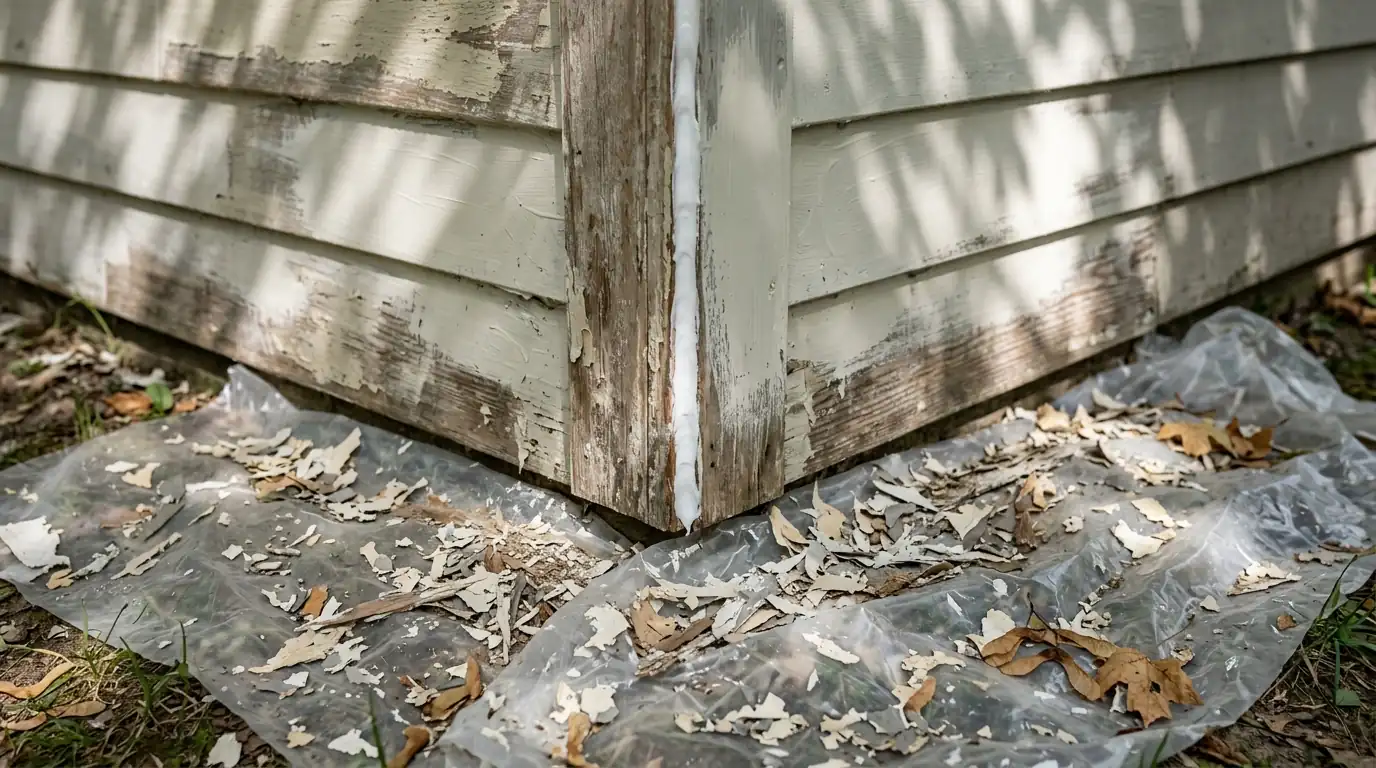
Nearly every Park Ridge, Niles and Des Plaines house built before 1978 may have lead in the bottom layers of exterior paint, and that covers the postwar ranches and Cape Cods as well as the 1920s homes. The EPA Renovation, Repair and Painting Rule applies to paid work that disturbs more than 20 square feet of painted surface outside a pre-1978 home, and a normal repaint crosses that quickly.
On those houses we follow EPA lead-safe work practices. Plastic sheeting goes down along the foundation and is weighted at the edges, we mist before we scrape, we sand by hand or with HEPA-connected tools, and we never burn paint off or dry power sand it. Chips are collected every day, and the job ends with a cleaning check. It takes longer than a quick scrape and spray, and it keeps chips out of your garden beds.
These are the signs we look for on a walk-around, usually on the south and west walls first.
Paint lifting along the lower edge of clapboards usually means moisture is getting behind it. It spreads a little more every winter.
If you rub the siding and your hand comes away colored, the binder has broken down and the coating is no longer protecting the surface.
Gaps where casings meet siding let rain and snowmelt straight into the wall. Caulk usually fails before paint does.
Wood that has turned gray has lost its surface fibers. It needs a light sanding and a primer before new paint will hold.
Press a screwdriver into a sill or the bottom of a door jamb. If it sinks in, that wood needs repair before any coating.
Dark spotting on shaded north walls has to be washed and treated, or it grows back through the new paint within a season or two.
We look at every side, note soft wood and failing areas, and agree on what is included. You get a written scope and price.
We wash siding and trim at a pressure that cleans without forcing water behind the boards, then give the house a dry day.
Loose paint comes off, edges get feathered, and soft wood is cut out and patched or replaced. Lead-safe setup goes in first on pre-1978 homes.
Bare wood and patches get a bonding primer. Open seams get a flexible exterior caulk.
Body and trim colors go on in two coats, timed to the sun and the overnight forecast.
We walk the house with you, fix anything you point out, and leave labeled leftover paint for future touch ups.
Exterior prices depend far more on prep and access than on the paint itself. These ranges cover the jobs we see most in the suburbs.
| What is priced | Typical range | Unit |
|---|---|---|
| Two-story frame or sided house, full exterior | $7,850 to $16,400 | per house |
| Brick ranch trim, soffits and garage door | $2,940 to $6,480 | per house |
| Wood rot repair before painting | $235 to $860 | per spot |
| Soffit and fascia painting | $4.35 to $9.80 | per linear ft |
These ranges are typical for suburban jobs, and the walk-through around your house sets the real number.
Full painting price guidePark Ridge streets are lined with old maples and oaks, which is lovely in July and hard on paint. Shaded walls stay damp longer after rain, grow mildew and drop paint along the bottom courses. We wash those walls with a mildewcide, give them extra drying time and pay close attention to the lowest boards, where snow sits against the house and salt spray from the street lands in winter.
In townhome communities in Palatine, Buffalo Grove and Wheeling, the association often approves exterior colors and may schedule painting building by building. Check your association's approved colors before we order paint, and we can match the existing scheme exactly or work through the approval list with you.
Oak Park, Evanston and Hinsdale have local historic districts where exterior changes can need review. Repainting already painted wood siding and trim is usually routine, but changing original features or painting brick or stone that has never been painted is more likely to draw attention. Check with the village or city first if your house sits in one of those districts.
We take exterior house painting jobs in Park Ridge and the suburbs around it. A few of the places we work most:
Most two-story Colonials take one to two weeks of working days, depending on prep and weather. Lead-safe scraping and heavy rot repair add time. Rain days pause the work, and we do not paint into a wet evening.
We often work into October when highs stay in the 60s, painting sunny walls in the middle of the day. Once overnight lows sit near freezing, as they average in November at O'Hare, we usually stop and pick up again in spring. The minimum temperature on the can decides the cutoff.
No. We need access to an outdoor spigot and an outlet, and windows closed on the side we are painting. We will ask you to move cars, grills and patio furniture before we start.
Yes. On a brick ranch or Georgian the trim, soffits, fascia and garage door are what weather, and keeping them sealed protects the wood behind them. It is a smaller job than a full sided house, typically a few days of work.
A well-prepped repaint on wood siding usually holds up for many years, with trim and the south and west walls showing wear first. Washing the house and recaulking every couple of years stretches it. Bare wood left unprimed fails much sooner.
Yes. Any pre-1978 home gets EPA lead-safe work practices: ground containment, misting, hand scraping, HEPA cleanup and no burning or dry power sanding. That setup is part of the price and the schedule.
Wood clapboard, cedar shingle, fiber cement and aluminum siding cleaned and coated with the right primer for each.
DetailsSoft sills, trim and porch parts cut back to sound wood, rebuilt with epoxy or new stock and primed before painting.
DetailsEaves, soffits, fascia boards and frieze trim painted from ladders and lifts, with soft spots flagged before coating.
DetailsSashes, frames and sills scraped, reglazed where loose and painted so windows still open and shed water.
DetailsFront porch floors, steps, ceilings, columns and railings scraped, repaired where soft and coated with porch enamel or stain.
DetailsCall any hour. Someone picks up, takes the details and books a time to walk the job with you.