Basement Painting
Foundation walls, block, ceilings and floors coated with products made for damp, cool below-grade rooms.
DetailsCommercial & multi-unit
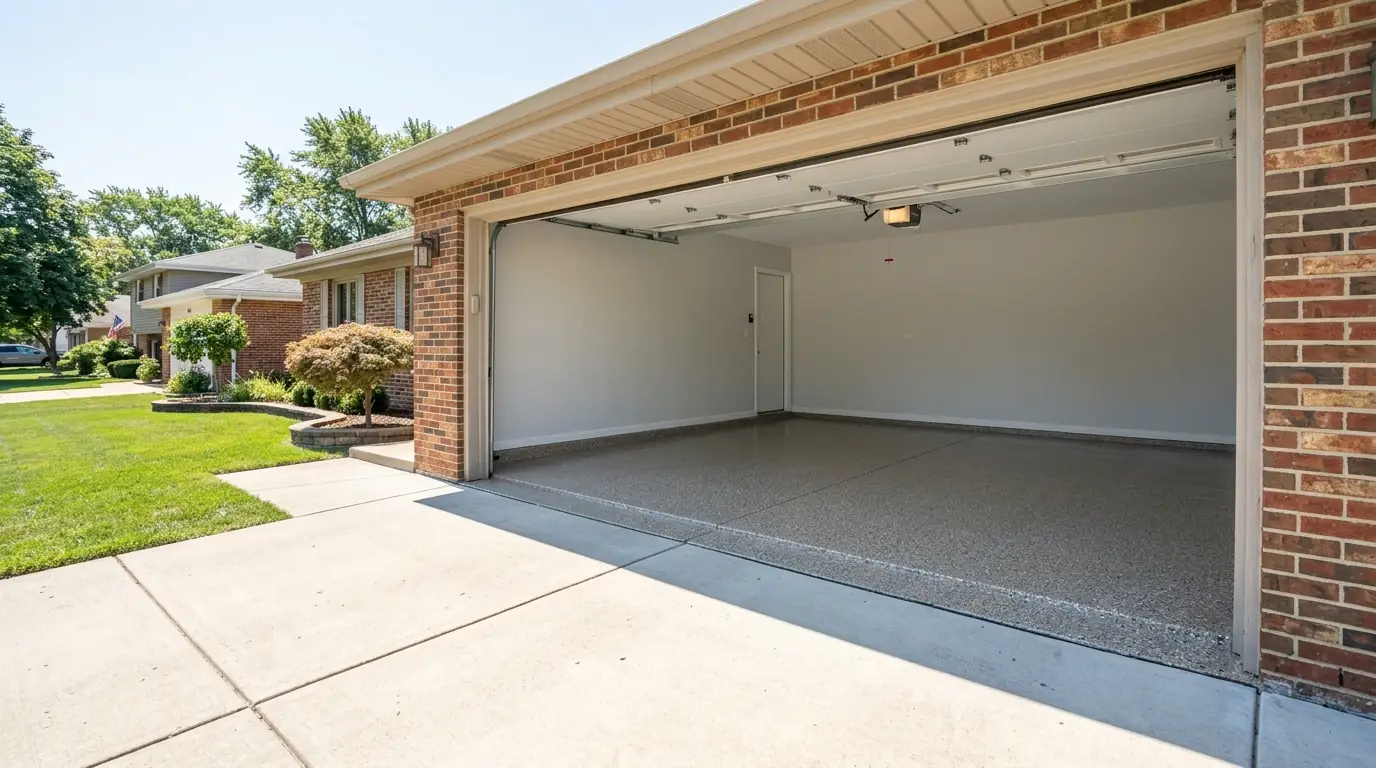
We coat garage, basement and shop floors in Park Ridge and the surrounding suburbs with epoxy and polyaspartic systems, grinding the concrete and repairing cracks and pitting first so the floor holds up to salty slush, hot tires and a damp basement.
Short answer
An epoxy floor coating is a hard, thick resin system locked into ground concrete, often with vinyl flake and a clear topcoat. Around Park Ridge and the nearby suburbs it typically runs $4.35 to $9.85 per square foot, or $2,180 to $4,760 for a two-car garage. Slab condition, crack and pitting repair, moisture coming up through the concrete, the system chosen and flake coverage move the price.
Paint lines we use most, matched to the surface: Benjamin Moore, Sherwin-Williams and PPG for walls and trim, Romabio for limewash, Cabot and Sikkens for wood stain.
Every winter, cars pull into attached garages carrying slush packed with road salt from Northwest Highway, the Tri-State and every plowed side street. That brine soaks into bare concrete, freezes and thaws through the season and slowly breaks the surface apart. The result is scaling: a pitted, flaking floor that is worst just inside the garage door and in the tire tracks.
A well-built coating seals the concrete so brine sits on top until it is squeegeed out the door. It also makes oil drips and de-icer residue easy to wipe up and brightens a dark garage. The thin one-part epoxy kits sold at home centers are a different product, and they often lift under hot tires within a year or two.
We use multi-coat systems: a penetrating primer or base coat, an optional broadcast of vinyl flake, and a clear polyaspartic or polyurethane topcoat that resists abrasion, chemicals and yellowing from sun through an open door.
Most floor coating failures trace back to prep. We grind the slab with a diamond grinder tied to a HEPA dust collector, which removes the weak top layer, old sealers and surface stains and leaves a profile the coating can lock into. Acid etching costs less, but it is far less reliable on an older garage slab that has soaked up oil and salt for decades.
Cracks are filled with a flexible or rigid repair material depending on whether they move. Pitted and spalled areas near the door are patched with an epoxy mortar and ground flush. Deep oil stains are degreased or ground out so they do not stop the coating from bonding.
Moisture is the second check. Basement slabs, and some garage slabs, push water vapor up through the concrete, which can blister a coating from below. We test before coating, and on damp slabs we use a moisture-tolerant primer or tell you plainly to fix the water source first.
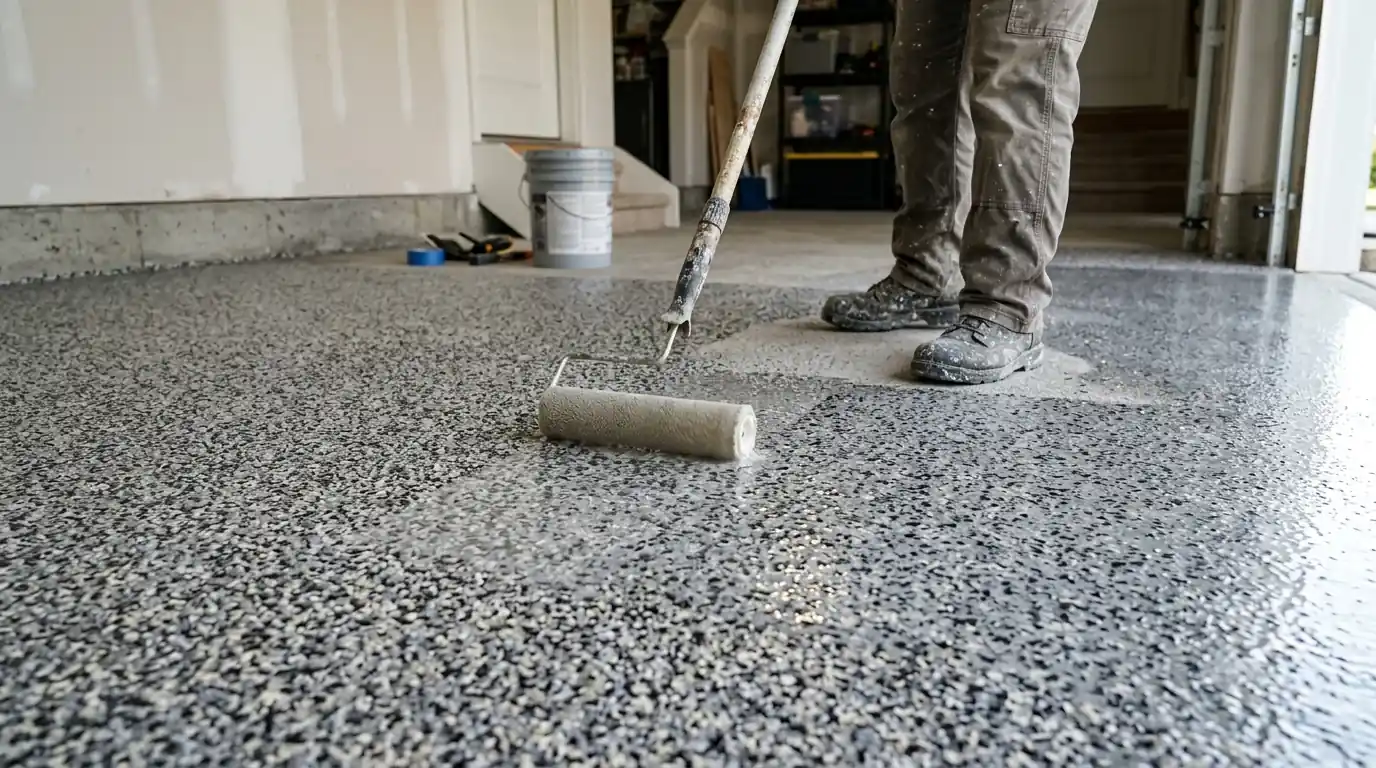
Epoxy is thick and hard and builds well over imperfect concrete, which makes it a strong base coat. It needs a longer cure, often several days before a car can come back in, and it can yellow in direct sun. Polyaspartic coatings cure much faster, handle a wider temperature range and resist UV, so we often use them as the topcoat, or as the full system when the garage can only be out of use for a day or two.
Vinyl flake broadcast into the wet base hides small flaws in the slab, adds texture for grip and makes dust less visible. A full broadcast covers the base completely, while a partial broadcast lets more of the solid color show. A fine grit can be mixed into the topcoat for extra traction on basement stairs and garage steps.
Basement floors are coated for different reasons: a cleaner surface for a laundry room, workshop or play area, and easier cleanup after minor seepage. Because basements stay cool and damp, testing and the right primer matter even more there.
These are the floor problems homeowners usually call us about.
Small craters and flaking concrete just inside the garage door are salt damage that keeps spreading each winter.
Chalky white marks that come back after every wash mean brine is soaking into bare concrete.
A thin epoxy kit lifting in the tire tracks has to be ground off before a real system can bond.
Bare concrete sheds fine dust that tracks into the house and settles on everything stored in the garage.
Dark stains under parked cars soak in deeper over time and make the floor look worse than it is.
A gray, stained basement floor makes a finished laundry room or workshop feel unfinished.
We check cracks, pitting, old coatings and oil stains, test for moisture and talk through how you use the space.
You clear the floor of cars and stored items, and we mask the walls, the door bottom and any steps.
The slab is diamond ground with dust collection, and cracks and pitted areas are filled and ground flush.
A penetrating primer or base coat goes down, followed by flake broadcast into it if you chose one.
Loose flake is scraped and vacuumed, then the clear topcoat is rolled on at the thickness the system calls for.
We tell you when foot traffic is fine and when cars can come back, based on the system and the temperature.
Floor coatings are priced by square foot, with the condition of the concrete and the system you choose setting where the job falls.
| What is priced | Typical range | Unit |
|---|---|---|
| Epoxy or polyaspartic floor system | $4.35 to $9.85 | per sq ft |
| Two-car garage, full system with flake | $2,180 to $4,760 | per garage |
| Basement walls painted to go with the floor | $1.65 to $3.90 | per sq ft |
These ranges are typical for floor coatings in the area; the inspection sets the real number for your floor.
Full painting price guideMost of the floors we coat are attached garages on postwar ranches, Georgians and split-levels in Park Ridge, Niles, Des Plaines, Mount Prospect and Arlington Heights, plus detached garages behind older bungalows. Slabs that are fifty or more years old have usually taken decades of salt, so grinding and pitting repair are a bigger part of the job than on a newer garage at The Glen or in Bartlett.
Basement floors come up often too, especially in neighborhoods near the Des Plaines River where high water has left stains and damp slabs, so moisture testing comes first there. We also coat small shop and warehouse floors in Elk Grove Village and Franklin Park. Temperature matters for the cure: epoxy wants a warm slab, so unheated garage work is easiest from May through early October, while polyaspartic systems handle cooler days in spring and fall.
We take epoxy floor coatings jobs in Park Ridge and the suburbs around it. A few of the places we work most:
A properly ground and coated floor with a polyaspartic or polyurethane topcoat holds up well to salt, because the brine sits on top instead of soaking in. Squeegee the slush out during heavy salt weeks and the finish stays clean. Thin hardware store kits are the ones that usually fail.
It depends on the system and the temperature. Polyaspartic topcoats often allow foot traffic within hours and cars in a day or two, while epoxy systems usually need several days. We give you exact times for your floor before we leave.
No. A peeling coating has already lost its bond, so we grind it off down to sound concrete before laying a new system. Coating over it would just fail along with the old layer.
Only after testing. If moisture coming up through the slab is high, a standard coating can blister from below. We use a moisture-tolerant primer when readings allow it, and if they do not, we tell you to fix the water source first.
A full flake broadcast gives some texture, and we can add a fine grit to the topcoat for more grip, which we suggest on steps and near the door. Any smooth floor gets slicker with snowmelt on it, so a mat at the entry still helps.
Epoxy needs a slab temperature in the range the maker lists, which an unheated garage usually cannot hold in winter. Polyaspartic systems tolerate cooler conditions, so late fall and early spring jobs are possible. Deep winter jobs work best in heated garages or basements.
Foundation walls, block, ceilings and floors coated with products made for damp, cool below-grade rooms.
DetailsSteel and wood garage doors cleaned, scuffed, primed where needed and painted in a finish that handles sun and salt.
DetailsOffices, storefronts and common areas painted on nights and weekends so tenants and customers are not disrupted.
DetailsSiding, brick, decks and walkways washed at the right pressure for the surface, as prep or as yearly upkeep.
DetailsCall any hour. Someone picks up, takes the details and books a time to walk the job with you.