Porch Painting
Front porch floors, steps, ceilings, columns and railings scraped, repaired where soft and coated with porch enamel or stain.
DetailsWall repair & prep
Freeze-thaw winters push water into every crack in exterior wood. We find the soft spots on window sills, porch posts, fascia and trim, cut them back to sound wood, rebuild them and prime before the paint goes on.
Short answer
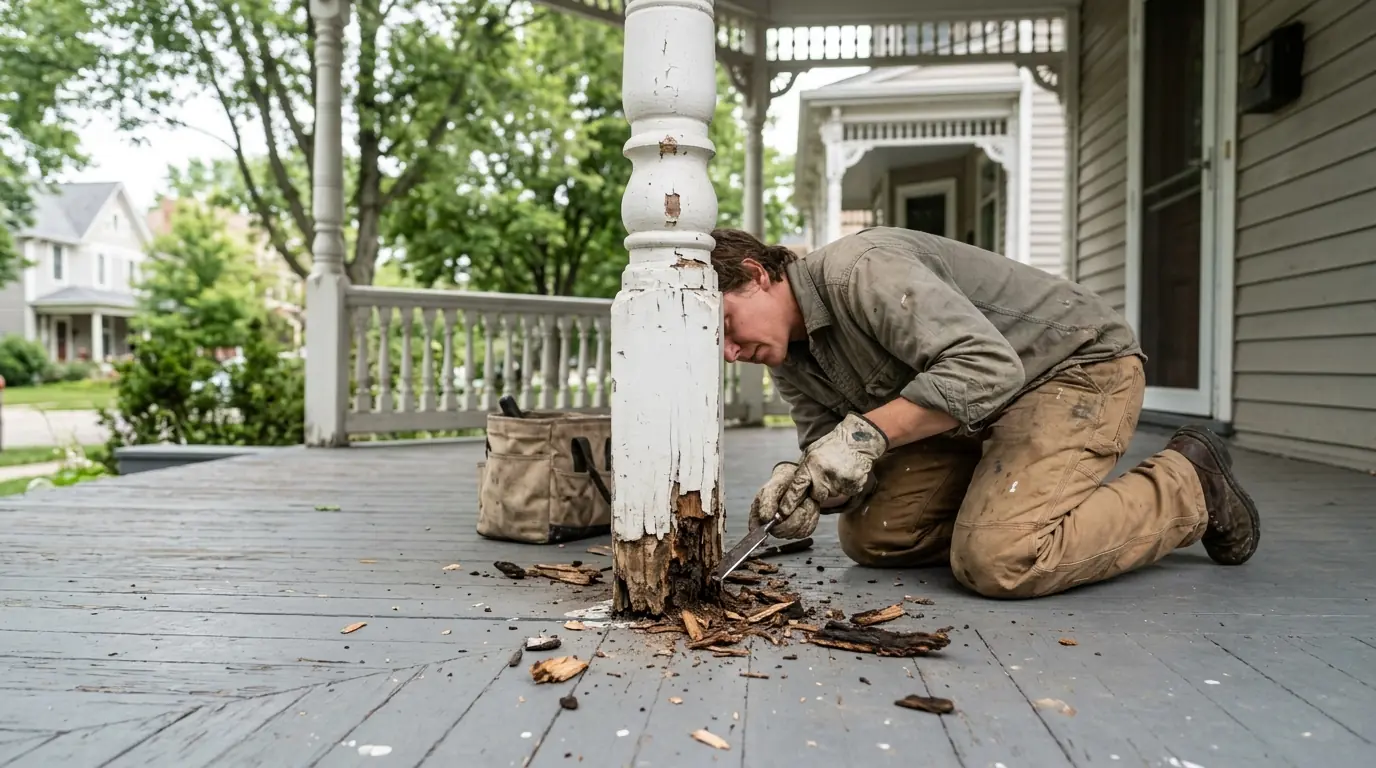
Wood rot repair means removing soft, decayed wood, hardening what is left, and rebuilding the missing section with epoxy filler or a new piece of wood, then priming and painting so water stays out. Around Park Ridge and the nearby suburbs, a typical repair runs $235 to $860 per spot, depending on how big the damage is, which part it is and whether that part carries weight.
Paint lines we use most, matched to the surface: Benjamin Moore, Sherwin-Williams and PPG for walls and trim, Romabio for limewash, Cabot and Sikkens for wood stain.
Rot is cheapest to fix when it is caught early, so walk the house after the snow melts.
Paint that keeps failing in the same place, especially low on trim or posts, usually means wet wood behind it.
If a screwdriver sinks in with light pressure, the wood fibers have broken down.
Wood that looks darker, swollen or cracked along the grain is holding water.
Fascia that bows, shows streaks below the gutter or pulls away at the corners has usually been soaked by overflow.
Posts that wobble or feel soft where they meet the floor may have rotted at the base.
Growth on porch floors, steps or shaded trim is a clear sign the wood is staying wet.
Wood rots when it stays wet long enough for fungi to grow, and winters here set that up every year. Snow sits on window sills and porch floors, melts in the afternoon sun, refreezes overnight and opens hairline cracks in the paint. Each melt pushes more water in, and by April the wood behind the paint is soaked.
Humid summers keep it from drying out, so the damage spreads from the inside. The face of a sill or a porch post can look fine while the wood behind it has gone soft. By the time the paint peels or a screwdriver sinks in, the rot has usually been working for a few seasons.
Fascia has its own cause. When gutters clog with leaves or ice dams form at the eaves, water spills over the back of the gutter and runs down the fascia board and into the soffit. On houses under big maples and oaks, that happens every fall.
We start by probing with an awl or a small screwdriver. Sound wood resists and rotted wood gives way. That tells us how far the decay runs and whether the part can be saved.
Small to medium damage on parts that carry no weight, such as sills, brick molding, trim corners, sash rails and the ends of fascia boards, is usually best repaired with epoxy. We cut out the soft wood, brush on a liquid epoxy consolidant to harden the fibers around it, then fill with a paintable epoxy filler shaped to the original profile. It keeps original trim that is hard to match.
Large damage, or parts that carry load, such as porch posts, stair stringers and long runs of fascia, gets new wood. On a porch post we may splice in a new bottom section, or replace the post if the rot runs high. If a part looks structural and badly damaged, we will tell you it needs carpentry before it is painted.
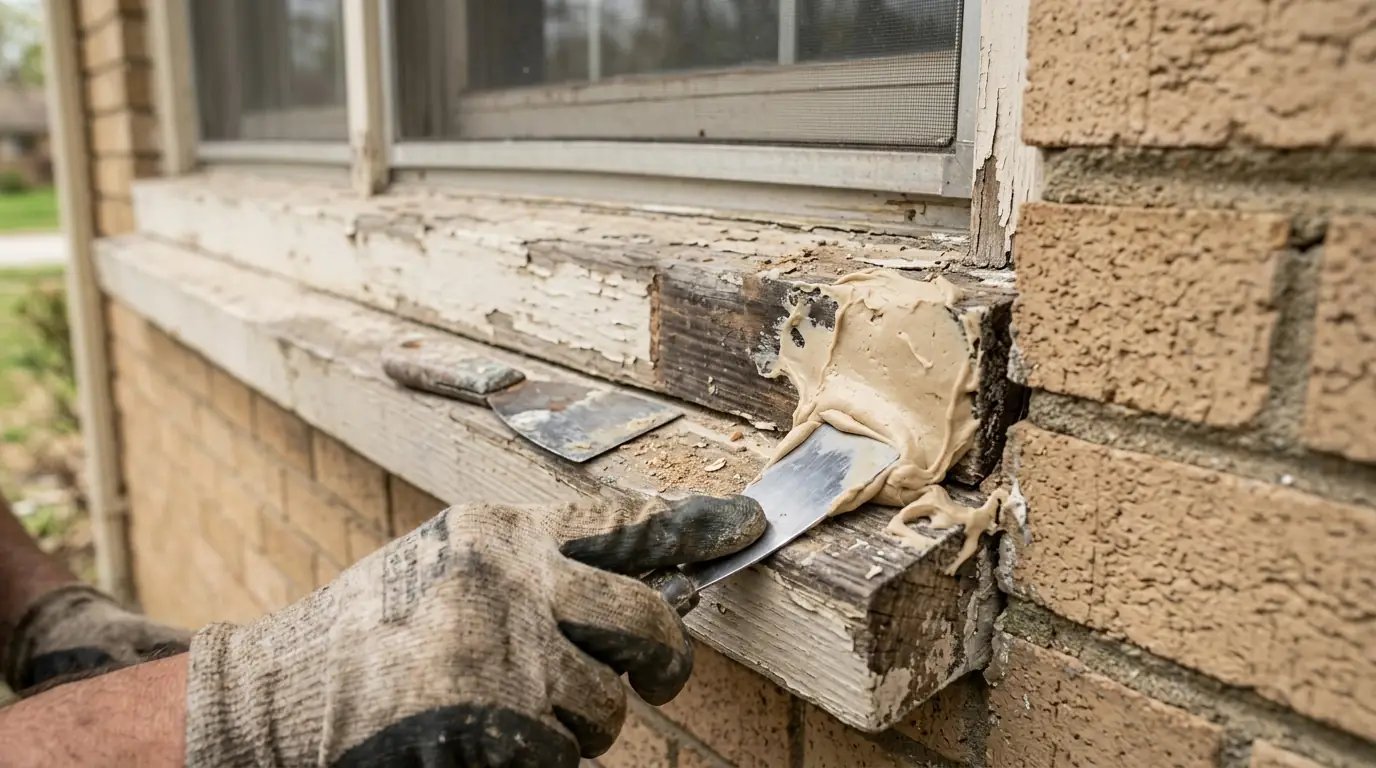
A repair lasts only if water stays out. Every repaired spot gets exterior primer on bare wood and epoxy, including end grain, which drinks water fastest. New wood is primed on all six sides before it goes up.
Joints between trim, siding and the repair are sealed with a paintable exterior sealant. On sills we check that the slope sheds water away from the window. On porch posts we look at how the base meets the floor and keep the end grain off standing water.
Then two coats of exterior paint go on. Porch floors and steps get a porch and floor enamel rated for foot traffic, so the finish handles salt, snow shovels and boots through the winter.
We probe sills, porch parts, fascia and trim, mark soft areas and show you what we found.
Small, nonstructural damage gets epoxy. Large or load-bearing damage gets new wood.
Rotted wood comes out until only hard, sound wood is left. On pre-1978 houses we follow EPA lead-safe work practices during this step.
Liquid epoxy hardens the remaining fibers, then epoxy filler or a new piece rebuilds the shape.
The repair is shaped to the profile, sanded smooth and primed, end grain included.
Joints are sealed and two coats of exterior paint or porch enamel finish the repair.
Rot is priced per repair spot, and the painting around it is priced as part of the larger exterior job.
| What is priced | Typical range | Unit |
|---|---|---|
| Wood rot repair | $235 to $860 | per spot |
| Window sash and frame painting | $185 to $465 | each |
| Front porch floor, steps and railings | $1,180 to $3,960 | per porch |
| Soffit and fascia painting | $4.35 to $9.80 | per linear ft |
These ranges are typical for the area, and the walk-through and probe test set the real number.
Full painting price guideOn the brick ranches and Georgians of Park Ridge, Niles and Des Plaines, the brick holds up and the wood does not. Window sills, brick molding, garage door jambs and fascia are where we find rot most. On Cape Cods and split-levels in Mount Prospect and Arlington Heights, the trouble spots are the lower corners of wood trim beside aluminum or vinyl siding, where water runs behind the siding and sits.
The older houses in Evanston, Wilmette, Winnetka, Oak Park and Glen Ellyn have front porches with turned posts, wood steps and original wood windows that have seen close to a century of winters. Those parts are often worth saving with epoxy, since a new piece rarely matches the old profile.
Exterior repair needs warm, dry days. Check the can on the epoxy and primer for the minimum temperature. At O'Hare, average highs reach 59F in April and 70.5F in May and fall back to 62.7F in October, so late spring through early fall gives the longest window for rot repair and the paint that follows.
We take wood rot repair jobs in Park Ridge and the suburbs around it. A few of the places we work most:
If the rot is limited to the base and the post is not carrying a damaged load, we can often cut out the soft section and splice in new wood or rebuild with epoxy. A post rotted far up its length needs full replacement.
A well-done epoxy repair can last many years once it is primed, sealed and painted, because epoxy does not rot. The wood around it still needs regular paint upkeep to stay protected.
Yes. Paint over rot traps moisture and the decay keeps spreading underneath. We repair first, then prime and paint so the new finish holds onto sound wood.
Leaves clog the gutters each fall, and ice dams form at the eaves in winter. Water then spills over the back of the gutter and soaks the fascia and soffit. Clean gutters and sealed, painted fascia slow it down a lot.
Yes. Epoxy filler can be shaped to the original profile, and for larger sections we fit new wood in a similar shape. Saving the original trim is often the best choice.
Late spring through early fall, when temperatures stay above the minimum on the epoxy and primer. Call (312) 579-0481 to get on the schedule before the busy summer months.
Front porch floors, steps, ceilings, columns and railings scraped, repaired where soft and coated with porch enamel or stain.
DetailsSashes, frames and sills scraped, reglazed where loose and painted so windows still open and shed water.
DetailsFull exterior repaints with scraping, priming of bare wood, caulking and two finish coats, timed to the local paint season.
DetailsEaves, soffits, fascia boards and frieze trim painted from ladders and lifts, with soft spots flagged before coating.
DetailsWood clapboard, cedar shingle, fiber cement and aluminum siding cleaned and coated with the right primer for each.
DetailsCall any hour. Someone picks up, takes the details and books a time to walk the job with you.