The short version
- Semi-transparent stain wears away, solid stain can peel
- Check cedar every spring for fading, salt wear and soft spots
- Repair soft wood before restaining, never stain over rot
- Decks usually need restaining before the siding does
Why cedar on suburban homes wears the way it does
Cedar is naturally resistant to rot, but the finish on it is not. Sun breaks down stain on the south and west faces, freeze-thaw cycles open small checks in the boards, and road salt splashing up from the driveway wears the bottom courses of siding and the lower fence rails. Shade causes its own problems: siding under big trees in Prospect Heights or the ravines of Highland Park stays damp longer and grows mildew.
Decks take the hardest beating because they are horizontal. Water sits on them, snow piles up through the winter and foot traffic grinds grit into the surface. A deck usually needs attention well before the siding on the same house.
None of this means cedar is a poor choice. It means the finish is a maintenance item, and catching problems early keeps restaining simple and keeps repair costs small.
Which stain type fits your cedar?
Stains run from clear to fully opaque, and the right one depends on how much grain you want to see and the condition of the wood. Brands like Cabot, Sikkens, Behr and Sherwin-Williams make products across this range. The main families are below.
Moving from a lighter stain to a heavier one is easy. Going the other way is not. Once a solid stain or paint is on the cedar, getting back to a semi-transparent look usually means stripping, which is slow and costly. Think about the long term before going solid.
- Clear and toned sealers: show all the grain, block some water, need recoating often because they have little UV protection
- Semi-transparent stains: the most common choice for cedar siding and decks, show grain and color the wood, wear away rather than peel
- Semi-solid stains: more pigment and more UV protection, some grain texture still shows
- Solid stains: opaque like paint, hide mismatched or weathered boards, last longer on siding but can peel on decks
- Oil-based versus water-based: oil soaks deeper into weathered wood, water-based dries faster and resists mildew; both have a place
A yearly cedar check you can do in an hour
Walk around the house once each spring, after the snow is gone and before it gets hot. Late April and May work well, with average highs at O'Hare around 59F in April and 70F in May. This is when winter damage is easiest to spot.
Look at the siding first. Check the south and west sides for faded, chalky or bare patches. Look at the bottom courses near the driveway and sidewalk for salt wear. Check around windows, doors and corner boards for gaps in caulk and dark stains that suggest water getting behind the boards.
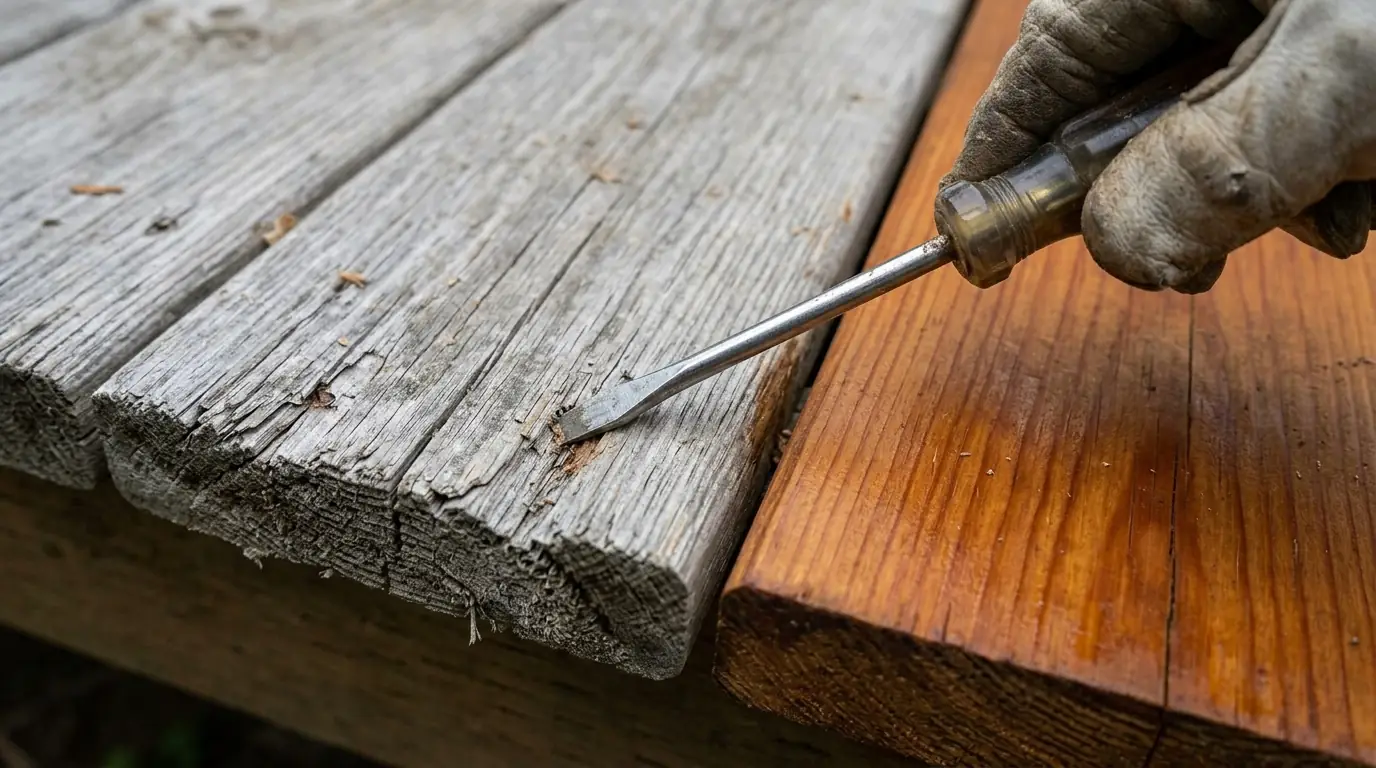
Then do the deck and fence. Sprinkle a little water on the deck boards. If it beads up, the finish is still working. If it soaks in quickly and darkens the wood, the deck is due. Press a screwdriver into the ends of boards, the bottoms of posts and the joists you can reach. Firm wood resists. Soft, spongy wood that lets the tip sink in needs repair.
When cedar needs repair before it can be stained
Stain does not fix damaged wood. It only protects wood that is sound. Before restaining, we check for soft spots, split boards, loose fasteners and gaps that let water behind the siding. Small areas of rot are often at the bottoms of corner boards, window sills, the lower ends of siding boards and deck boards near the house, where water collects.
Small soft spots can be cut back to sound wood and filled with epoxy, or replaced with a matching piece of cedar. Larger areas, such as deck boards that have rotted through or posts that are soft at the base, need new wood. Deck framing that is soft or loose is a structural issue, and a carpenter should look at it before any finish work.
We prime or pre-treat any new cedar where the product calls for it, so the replacements accept stain the same way as the old boards. On a semi-transparent finish, new boards may still look lighter for a season while they weather in.
- Spongy wood under a screwdriver tip
- Boards split along the grain or cupped badly
- Nails or screws pulling out and boards lifting
- Black staining around fasteners or at board ends
- Peeling solid stain with bare gray wood underneath
How we prep and restain cedar the right way
Prep makes or breaks a cedar stain job. We wash the wood at a pressure suited to cedar, which is gentler than you might expect, since high pressure raises fibers and gouges the surface. We follow with a cleaner or a brightener where the wood has grayed, to restore color and help the stain absorb evenly.
The wood has to dry fully before staining, often a couple of days in good weather. We watch the forecast and apply when the temperature is above the minimum on the can, the wood is dry and rain is not expected for at least a day. In early spring and late fall, cold nights can slow drying, so check the can for the product's minimum temperature.
On siding we brush or back-brush every board so the stain works into the grain. On decks we do the tops of the boards, the edges and any rails and spindles. Fences get both sides when the neighbor agrees, with plants and the neighbor's yard covered.
How often to restain and what it costs
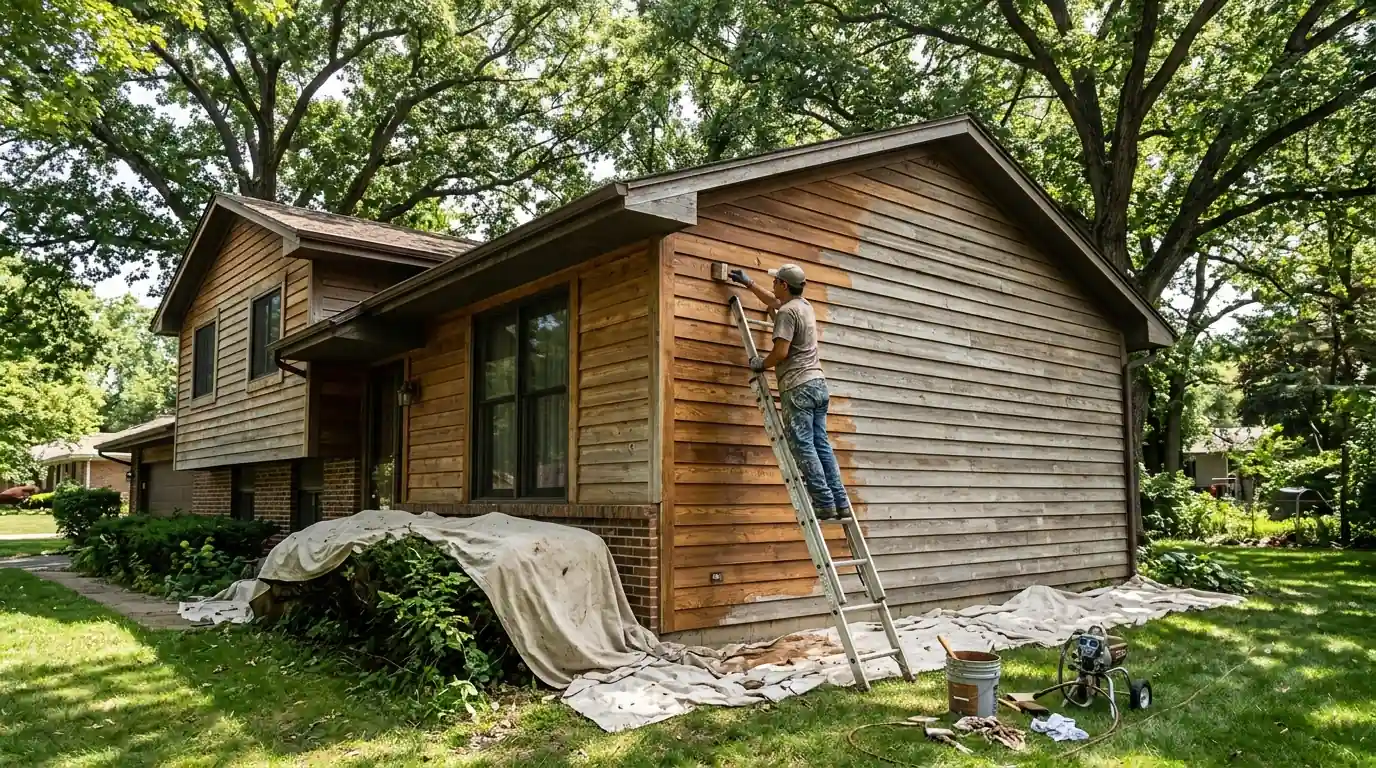
On cedar siding, a semi-transparent stain often lasts a few years, longer on shaded faces and shorter on south and west walls. Solid stains last longer. Decks usually need attention more often than siding because they are horizontal and walked on. Your yearly check will tell you more than any fixed schedule.
Typical ranges: cedar siding stain runs $1.95 to $4.40 per square foot, a 300 to 500 square foot deck runs $985 to $2,640 and fences run $3.20 to $7.45 per linear foot. Pressure washing a house runs $345 to $890 if needed separately, and wood rot repair runs $235 to $860 per spot. The price moves with the condition of the wood, how much stripping is needed, the stain type, access for ladders and how much repair turns up. Call (312) 579-0481 at any hour to set up a walk-through.
Questions about this topic
Can semi-transparent stain go over cedar siding that already has solid stain?
Not with a good result. A semi-transparent stain needs to soak into bare wood, and solid stain blocks that. To change to a semi-transparent look, the solid stain usually has to be stripped first, which adds labor and cost.
What month is best for restaining a cedar fence in the northwest suburbs?
Late spring and early fall are usually best, when temperatures are mild and rain is less frequent. Midsummer works too if we avoid full afternoon sun, which can make stain dry too quickly. The wood must be dry and the forecast clear for at least a day.
Should the cedar deck boards be replaced or just restained?
If the boards are firm under a screwdriver and only faded or grayed, cleaning and restaining is enough. If boards are soft, split through or lifting, those boards should be replaced first. Soft joists or posts need a carpenter before any finish work.