The short version
- Use a heat-rated enamel over metal primer, never plain wall paint
- Two thin coats beat one heavy coat on cast iron
- Treat paint on pre-1978 radiators as leaded until tested
- Skip metallic finishes on radiators that already run weak
Where do cast iron radiators still show up around Park Ridge?
Radiators are most common in homes built before the 1950s. That means the brick bungalows in Berwyn, Melrose Park, Villa Park and the older blocks of Elmhurst and Lombard, the Victorians and Prairie homes in Evanston, Oak Park and River Forest, and the big Tudors and Georgians in Wilmette, Winnetka and Glen Ellyn. Some postwar houses kept boiler heat too, though many of those switched to baseboard units or forced air.
Before choosing a paint, figure out which system you have. A steam radiator usually has one pipe at one end and a small air vent screwed into the side near the top. A hot water radiator usually has two pipes, one at each end or both at the bottom, and a small bleed valve instead of a vent. If you are not sure, the person who services your boiler can tell you in a minute.
The system matters because steam radiators run hotter at the surface than most hot water systems. A coating that behaves on a lukewarm hot water unit can soften, yellow or blister on a steam radiator by January.
Which coatings actually hold up on a hot radiator?
Regular latex wall paint is the wrong product. It may look fine for a season on a cool unit, but on a hot one it tends to go soft, collect dust and lift at the edges of each section. Traditional oil enamels last longer, though white and pale colors can yellow on the hottest units over time.
What we use most is an enamel labeled for radiators or for metal that sees heat, over a rust-inhibiting metal primer on any bare or rusty spots. Rust-Oleum and other makers sell heat-rated enamels in brush and spray versions. The label gives the temperature rating, recoat time and cure instructions, so check the can and make sure the rating clears what your system reaches. Stove and grill paints are rated far above what a radiator needs and usually come only in flat dark colors.
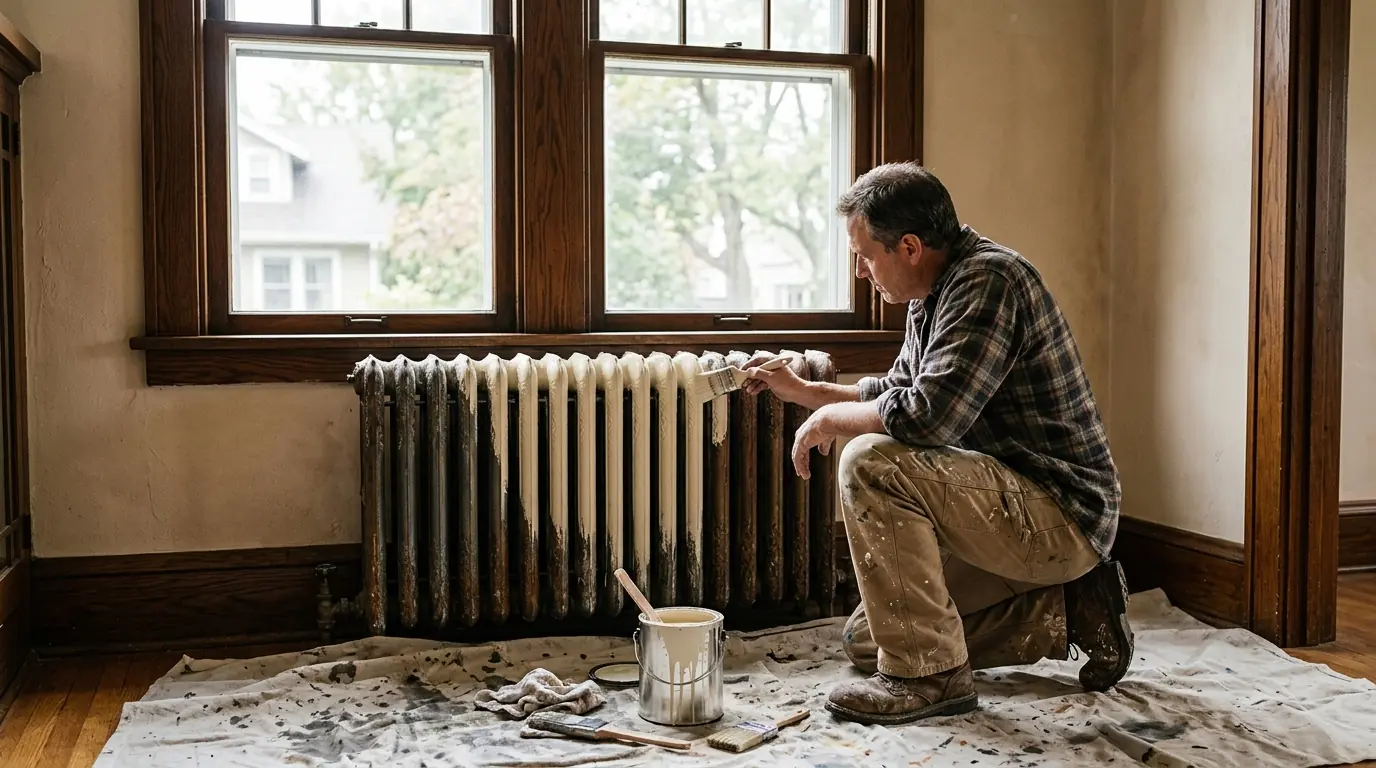
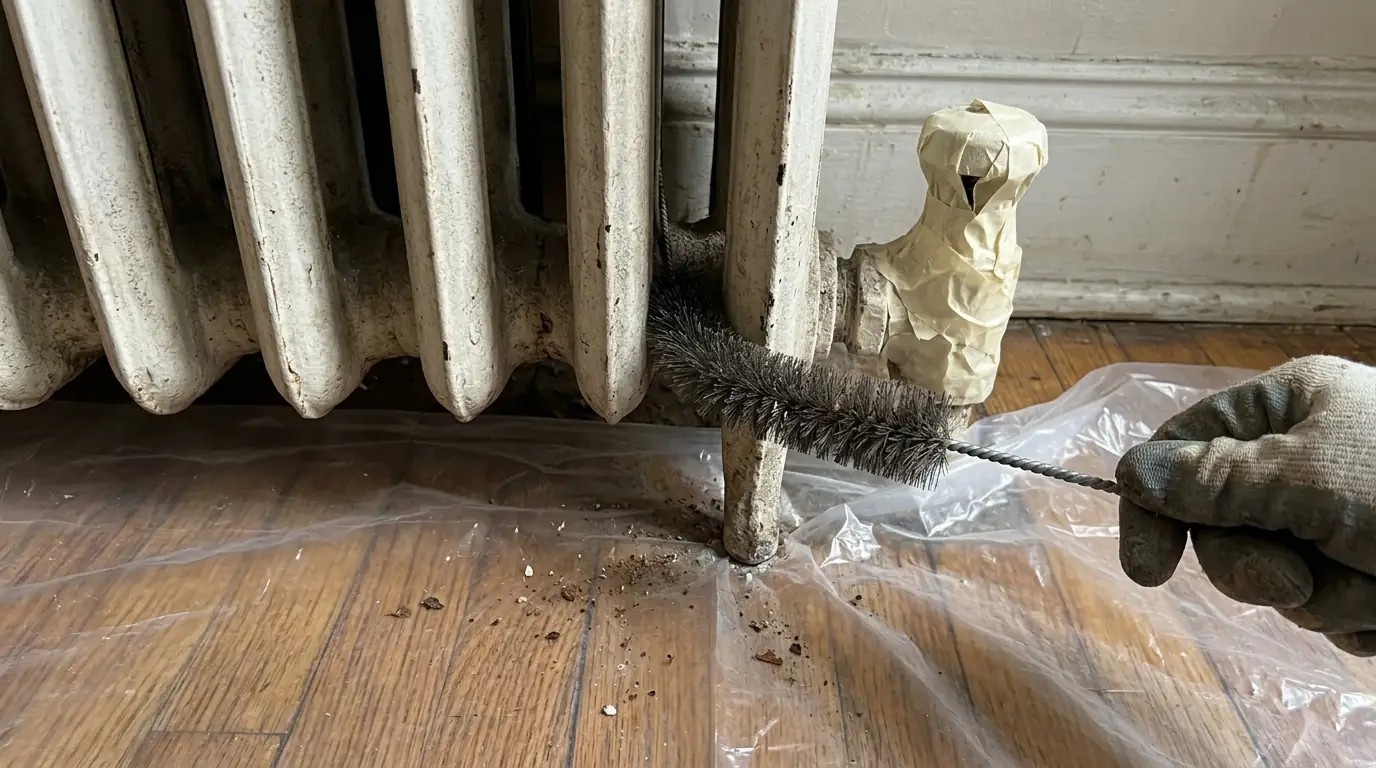
Thin coats matter more than the brand. Cast iron has deep gaps between the columns, and a heavy coat pools there, stays soft and wrinkles once the heat comes on. Two light coats from a sprayer or a long, bent radiator brush give a far more even film than one thick pass.
What to know about lead in old radiator paint
Any radiator in a home built before 1978 should be treated as if its paint contains lead until a test says otherwise. Radiators were often painted every time the room was, so a single unit can carry many layers, and the oldest ones are the most likely to contain lead. Flaking paint near the floor is a particular concern in homes with small children or pets.
The EPA Renovation, Repair and Painting Rule covers paid work that disturbs more than 6 square feet of painted surface inside a room on pre-1978 homes. A few radiators can pass that number quickly once you count every column face. We follow EPA lead-safe work practices on that work: plastic sheeting on the floor and nearby walls, wet scraping and wet sanding, no open-flame burning and no dry power sanding, HEPA vacuums for the dust and a cleaning check before we leave the room.
If the old paint is thick, cracked and failing everywhere, full stripping is sometimes the better answer. That usually means a heating contractor disconnects the radiator and it goes to a shop for stripping or blasting, then comes back for reinstallation. For radiators with sound old paint and a few chips, careful wet prep and a fresh coating is the usual route.
Does color or a metallic finish change how much heat you get?
This is where a lot of advice gets overstated. Radiators give off heat partly by warming the air that moves past them and partly by radiating it into the room. Older heating references note that metallic finishes, such as the bronze and aluminum paints popular a century ago, can reduce the radiant part compared with nonmetallic paint. Ordinary colored enamels, light or dark, appear to make much less difference than people expect.
We do not promise a heat gain or loss from any paint choice, because the effect depends on the system, the room and how many layers are already on the iron. Our practical rule is simple. If a radiator already struggles to keep a room warm, we skip metallic finishes on it and keep the total paint film as thin as we can. If the room heats fine, choose the color you like.
Covers, shelves and heavy curtains in front of a radiator usually have a bigger effect on comfort than the paint does, so keep that in mind before blaming the finish.
How we prep and paint a radiator, start to finish
The heat has to be off and the iron cool to the touch. Painting a warm radiator traps solvent in the film and causes bubbling. We schedule radiator work between late spring and early fall, or we work with you to shut off individual valves in a cold month.
The order we follow keeps the dust down and the finish thin.
- Cover the floor and wall behind the unit, and set up lead-safe containment on pre-1978 homes
- Vacuum dust out from between the columns, then wash off grease and grime and let it dry
- Wet scrape and hand sand loose paint, and treat surface rust with a wire brush and a rust-inhibiting primer
- Mask the valve, air vent, bleed valve and pipe unions so they still work after painting
- Apply two thin coats of heat-rated enamel, reaching deep between columns with a radiator brush or sprayer
- Let the finish cure for the time on the label before turning the heat back on
When to schedule it and what radiator painting costs
The easiest window is May through September, when the boiler is off anyway and windows can stay open while the coating dries. By October the average high at O'Hare has dropped to about 63F and many homes have the heat running again, so fall radiator work takes more planning around each room.
Radiator painting typically runs $165 to $385 per radiator. What moves the price is size and column count, how much loose paint and rust has to come off, whether the unit sits under a window or in a tight corner, and whether you want the wall behind it painted at the same time. On pre-1978 homes, lead-safe setup adds $145 to $385 per room, and doing several radiators in one room spreads that cost across them.
A walk-through sets the real number, and we can usually look at every radiator in the house in one visit. Call (312) 579-0481 any time of day to set one up.
Questions about this topic
Can a cast iron radiator be painted while the boiler is still running?
We do not paint radiators that are warm. The heat pushes solvent out of the wet film too fast, which causes bubbles and soft spots. We either schedule the work while the boiler is off or close the valve on that radiator and let it cool fully first.
Should the air vent on a steam radiator get painted along with the iron?
No. Paint can clog the small opening in a steam air vent and keep the radiator from heating. We mask the vent, the inlet valve and any pipe unions, then remove the masking once the coating is dry.
How long should a freshly painted radiator sit before the heat goes back on?
Follow the cure time printed on the can for the product used, which is often several days rather than a few hours. Some heat-rated enamels also tell you to bring the temperature up gradually the first time. We leave you a note with the product name and the date the heat can return.
Is it worth sending an old radiator out for stripping instead of repainting it in place?
It can be, when the paint is thick, cracked and lifting everywhere, or when you want a bare metal restart. That job needs a heating contractor to disconnect and reinstall the radiator. For units with mostly sound paint, wet prep and recoating in place costs much less.